





Padel Rules
Official Padel Rules - International Padel Federation (FIP)
The official FIP padel rulebook: player positioning, serve mechanics, scoring, and match conduct, presented in a clean and practical format.
Table of contents
- Player Positioning
- Choice of Side and Serve
- How to Serve in Padel
- Service Fault
- Order of Serving
- Returning the Serve
- Order of Return
- Number of Serves
- Receiver Readiness
- Serve Hits a Player
- Replay of a Point (Let)
- Interference
- Scoring System
- Tie-Break
- Ball in Play
- Volley
- Ball Rebound from Court Installations
- Correct Return
- Losing the Point
- Temporary Rules
- Continuous Play
- Ball Change
- Punctuality
- Dress Code
- Identity Verification
- Conduct and Discipline
1) Player Positioning
Padel is played in doubles, with players positioned on opposite sides of the net. The serve starts the point, and the receiver returns it. Players may stand anywhere on their side of the court, including each server's and receiver's partner.
Players change court sides when the total number of games played is odd. The maximum rest time between games is 90 seconds.
| Aspect | Details |
|---|---|
| Format | Doubles play, one pair on each side of the net |
| Side change | After an odd number of games |
| Rest interval | Maximum 90 seconds between games |
2) Choice of Side and Serve
The choice of side and the right to serve in the first game are decided by draw. The winning pair may choose to serve/receive, choose court side, or let opponents choose first.
- Choose to serve or receive (the other pair chooses side).
- Choose court side (the other pair decides serve or receive).
- Ask the opponents to choose first.
3) How to Serve in Padel
The serve has strict rules to ensure a fair start to each point.
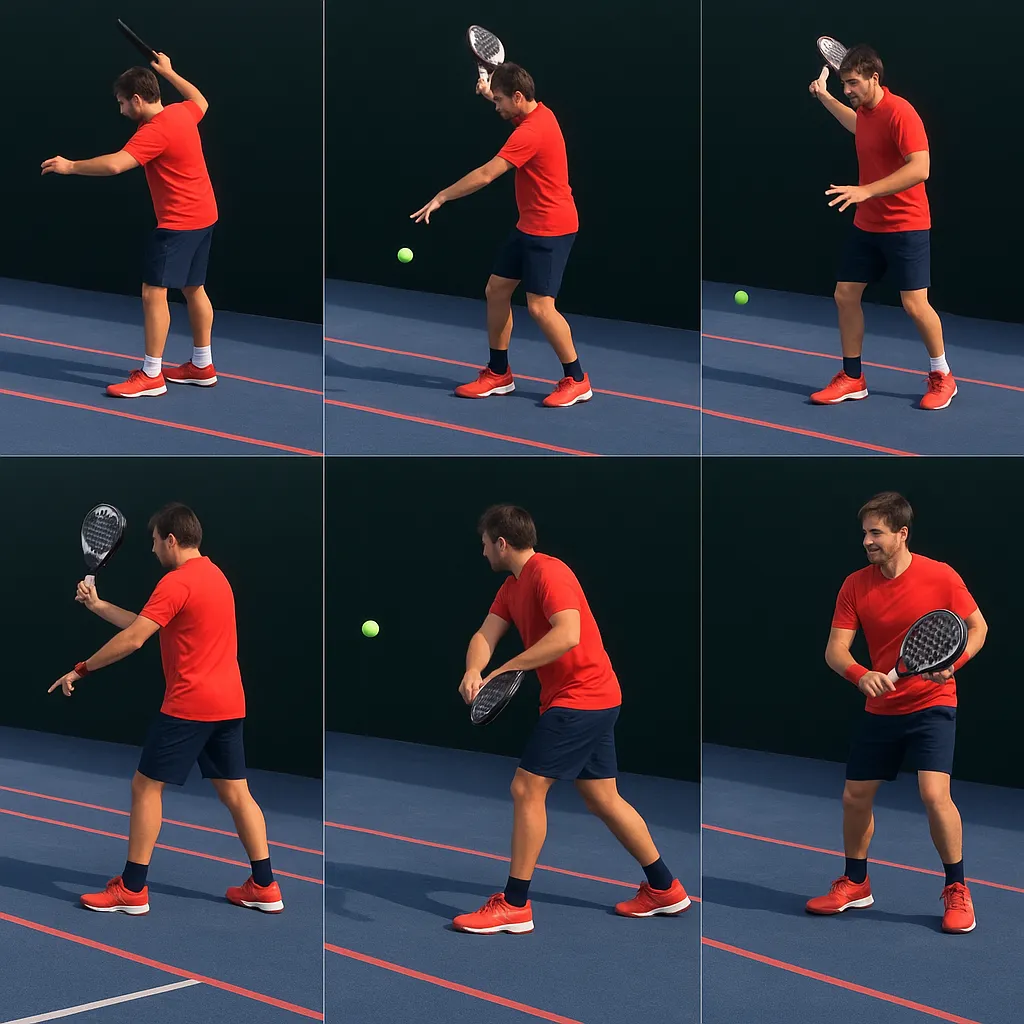
- Position: both feet behind the service line, between center line and side wall.
- Trajectory: diagonal serve into the opposite service box, landing inside or on the line.
- First serve: starts from the right side, then alternates.
- Bounce before contact: the ball must be hit after bouncing behind the service line.
- Players with disabilities: one-arm players may use the racket to bounce the ball.
- Restrictions: contact point must be at waist level or below, with at least one foot on the ground.
- Movement: server cannot walk, run, or jump during serve execution.
- Miss: if server misses the ball, it counts as a serve attempt.
- Wrong side: if served from the wrong side, correct immediately; points already played remain valid.
4) Service Fault
The following situations are considered service faults:
| Fault Type | Description |
|---|---|
| Service rule violation | Server does not comply with serve execution rules. |
| Complete miss | Server fails to strike the ball during serve attempt. |
| Incorrect bounce | Ball lands outside receiver's service box. |
| Partner hit | Ball strikes the server's partner. |
| Fence contact | Ball touches opponents' fence before second bounce (on serve). |
5) Order of Serving
The pair that serves first in a set chooses which player serves first. In the next game, the receiving pair serves. This alternation continues through the set. Serve order cannot be changed until the next set.
6) Returning the Serve
Serve return has clear rules:
- Receiver must wait for a bounce in the service box and return before second bounce.
- If ball bounces twice in the box, serve is valid and server wins the point.
- On courts with corner structures, serve is valid only if ball continues toward receiver.
- If receiver strikes before bounce, the point is lost.
7) Order of Return
The receiving pair chooses who returns first in the opening game of the set. That player continues returning the first serve of each game in that set. Return order can only be changed at the start of the next set.
8) Number of Serves
The server has a second serve if the first serve is invalid. The second serve must be taken from the same side, immediately.
9) Receiver Readiness
The server may not serve until the receiver is ready. If receiver is not ready, the server cannot claim the point even when the serve is technically good.
Receiver may stop play if unready, but the 25-second rule between points still applies.
10) Serve Hits a Player
If the receiver or the receiver's partner is hit by the served ball, or touches it with the racket before bounce, the serving pair wins the point.
11) Replay of a Point (Let)
A point is replayed in these cases:
- Ball touches net/posts and lands in receiver's box without touching fence before second bounce.
- Ball touches net/posts and then strikes a player.
- Receiver is not ready.
If a let occurs on first serve, first serve is repeated. On second serve, the server gets one additional serve only.
12) Interference
If a player is disturbed by an external factor beyond control, a let is played. If a player disturbs an opponent, the umpire may award the point to opponents or order a replay.
13) Scoring System
Padel uses tennis-style scoring:
- First point: 15
- Second point: 30
- Third point: 40
- Fourth point: game (except at 40-40 / deuce)
At deuce, next point gives advantage. If same pair wins the following point, they win the game; otherwise score returns to deuce. A set is won at 6 games with a minimum 2-game lead.
14) Tie-Break
At 6-6, if competition format allows, a tie-break is played. The first pair to reach 7 points with a 2-point lead wins.
Service starts from the right with one serve, then alternates in two-serve sequences. Players change ends every 6 points.
15) Ball in Play
The ball remains in play while legal trajectory and bounce conditions are respected:
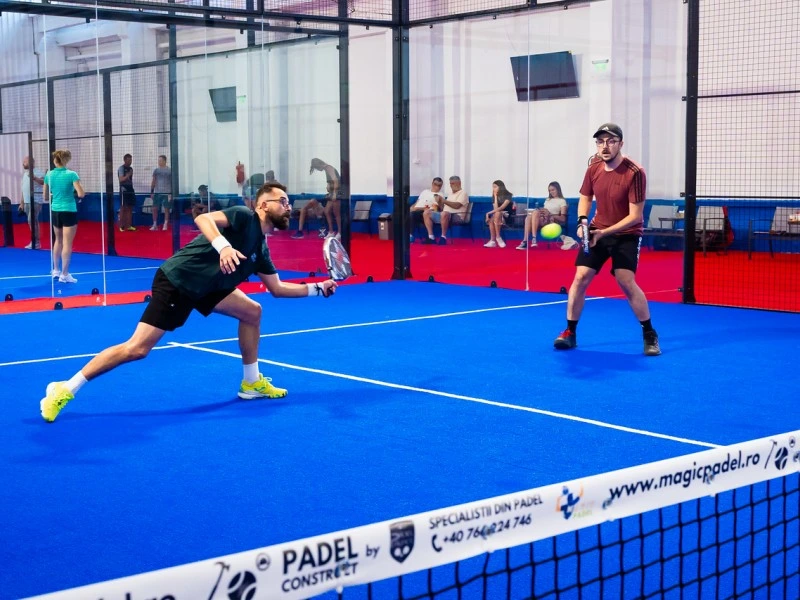
- Teams hit the ball alternately.
- Ball is out if it directly hits opponents' walls/fence without legal sequence.
- Ball is out if it bounces twice before return.
- Players may hit outside court limits if allowed by court design and before second bounce.
16) Volley
Any player may hit volleys, except during serve execution.
17) Ball Rebound from Court Installations
If the ball rebounds from court installations after touching the playing surface, it remains in play and must be returned before second bounce.
If the ball hits lights or roof on covered courts (as defined by venue rules), point ends.
18) Correct Return
A return is valid if:
- Ball touches net/posts and legally rebounds into opponents' court.
- Ball returns legally after wall rebound and is played without fault.
- Ball exits court boundaries after legal bounce in opponents' side.
19) Losing the Point
A pair loses the point if:
- A player/racket/equipment touches net, posts, or opponents' court.
- Ball bounces twice before return.
- Ball is volleyed before crossing the net.
- Ball directly strikes opponents' walls/fence in a fault sequence.
20) Temporary Rules
On some courts, if the ball passes through a gap between net post and fence, it is only considered good if the umpire judges it to have passed above net level.
21) Continuous Play
Play should be continuous except for authorized breaks: 90 seconds between games, and up to 10 minutes after set three in five-set formats.
If suspended due to external conditions (rain, lighting), warm-up may be allowed on restart, depending on interruption length.
22) Ball Change
Ball changes follow competition regulations. In semifinals and finals, balls are commonly changed after the first 11 games, then every 13 games.
Punctuality
Matches begin at scheduled time. If a player is absent 10 minutes after scheduled start, the opposing pair may be declared winner.
Dress Code
Players must wear clean, appropriate sportswear. Non-compliant attire can lead to warnings or disqualification under tournament regulations.
Identity Verification
Players must be able to prove identity, nationality, or age when requested by the umpire, through valid official documents.
Conduct and Discipline
Players must behave respectfully and follow tournament rules:
- They may not leave the playing area without umpire authorization.
- Coaching is only allowed according to event-specific regulations.
- They must attend award ceremonies except in proven medical cases.
- Unjustified delays between points or at side changes may be penalized.
- Audible/visible obscenities, ball/racket abuse, and aggressive behavior are sanctionable.
Note: These rules apply across FIP events and player categories.
Official FIP rules in English: Official Padel Rules (PDF)

Also from our team:
PadelStartup.com — The Padel Club Startup Guide|OpeningPadelClub.com — Padel Consulting© 2026 Padel Guide USA LLC, New York, NY, United States. All rights reserved.